About Deep River & Northern Renfrew County Well Drilling
Deep River, Ontario, sits on the south shore of the Ottawa River within the Laurentian Hills township. This area of northern Renfrew County presents unique conditions for residential well drilling. The underlying geology is Canadian Shield Precambrian granite — among the hardest rock formations in Ontario. This hard granite diorite and gneiss bedrock influences every aspect of well construction, from drilling speed and cost to water quality and yield.
Communities throughout this region — including Deep River, Chalk River, Petawawa, Pembroke, Rolphton, Mackey, Stonecliffe, Bissett Creek, Beachburg, and Cobden — all rely on groundwater for their rural properties. Unlike southern Ontario where overburden aquifers provide shallower wells, northern Renfrew County wells must be drilled into bedrock fractures that carry groundwater. Understanding local geology is essential for property owners planning a new well.
The Canadian Nuclear Laboratories (CNL) and Atomic Energy of Canada Limited (AECL) operations near Chalk River and Deep River mean some properties are located in areas of heightened regulatory oversight. Properties near the Ottawa River in the Deep River area may also have unique hydrogeological considerations. Property owners should always check with Laurentian Hills township and local conservation authorities before any drilling work.
Typical residential well depths in the Deep River area range from 80 to 200 feet, though some properties require significantly deeper drilling to reach adequate fractures. The hard granite means drill penetration rates are generally slower — and therefore more expensive per foot — than in areas with softer sedimentary rock. This guide covers everything northern Renfrew County property owners need to know about well drilling costs, regulations, maintenance, and hiring.
Well Drilling Costs in Deep River and Northern Renfrew County
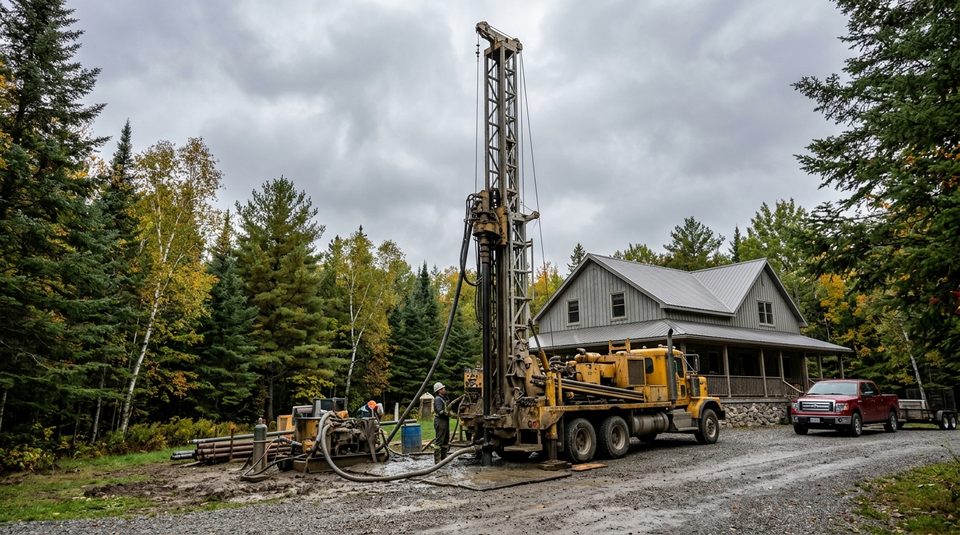
The cost of drilling a residential well in northern Renfrew County involves multiple components. Drilling alone — at $30–$55 per foot for rotary percussion method in hard Shield granite — is just one part. A complete well system includes steel casing, a submersible pump, pressure tank, water supply line to the house, electrical service, and various fittings. Total installation costs in the Deep River area typically range from $7,000 to $15,000 depending on depth, accessibility, and materials chosen.
| Cost Component | Typical Range (CAD) | Basis / Notes |
|---|---|---|
| Drilling — per foot | $30 – $55 / ft | Rotary percussion in hard Shield granite; Deep River/Chalk River area at upper end |
| Mobilization / rig setup | $400 – $1,200 | Higher for remote properties (Rolphton, Mackey, Stonecliffe) |
| Steel casing (6-inch) | $1,200 – $3,500 | Overburden depth dependent; includes grouting |
| Pump system (submersible ½–1 HP) | $1,000 – $3,200 | Pump, drop pipe, wiring, safety rope, installation labour |
| Pressure tank | $450 – $1,200 | Bladder-type; 44–86 gal typical for residences |
| Water supply line to house | $1,500 – $6,000 | Buried below frost depth (4–5 ft in Renfrew County); depends on distance |
For a more detailed breakdown including all possible cost components, see the full well drilling cost guide.
Canadian Shield Geology of Deep River and Chalk River
The Deep River area lies squarely within the Grenville Province of the Canadian Shield, characterized by metamorphosed gneiss, granite, and diorite — some of the most resilient rock on the continent. This geology has significant implications for well drilling. The rock is hard, dense, and fractures unpredictably. Drillers working in this region encounter slow drilling rates and variable yields depending on the local fracture network.
The CNL site near Chalk River sits on a particularly hard granitic batholith, and properties in the immediate vicinity may face exceptional drilling challenges. The Ottawa River valley provides some areas with deeper overburden (sand, gravel, clay over bedrock), but most residential wells in the Deep River and Chalk River area still terminate in bedrock fractures.
An important consequence of the uranium-bearing Shield geology in this region is the potential for naturally occurring radon gas in well water. Testing for radon is recommended for any private well in northern Renfrew County, particularly in areas near Chalk River and Deep River where uranium-bearing minerals are present in the bedrock.
Ontario Well Drilling Regulations
All well drilling in Ontario is governed by Ontario Regulation 903 (Wells) under the Ontario Water Resources Act. This regulation sets standards for well construction, maintenance, and abandonment. Key requirements include:
- All wells must be drilled by a licensed well contractor registered with the Ontario Ministry of the Environment, Conservation and Parks (MECP)
- Proper casing and sanitary well cap are mandatory to prevent surface contamination
- Minimum setback distances apply: 15 metres from septic tanks, 30 metres from septic beds, 15 metres from property lines
- All new wells require a Well Record to be filed with the MECP within 30 days of completion
- Well shocking (chlorination) is required after drilling to disinfect the well
Municipalities in northern Renfrew County — including Laurentian Hills (Deep River) and the Town of Petawawa — may have additional property-related requirements. Always check with the local township office before scheduling any drilling work.
Read Ontario Regulation 903 (Wells) on the Ontario government website · Search Ontario Well Records
For a more detailed guide to Well Regulation 903 requirements, see the regulations guide.
Explore Our Guides
Well Drilling & Installation
How rotary percussion drilling works in hard Shield granite. Typical depths, casing types, and the step-by-step process for Deep River area wells.
Read GuideWell Pumps & Pressure Tanks
Submersible vs jet pumps for deep wells. Pressure tank sizing, seasonal shutdown for Ottawa River cottage properties, and common failure signs.
Read GuideWater Testing & Treatment
Radon testing in uranium-bearing Shield geology. Iron, manganese, hardness, and arsenic concerns. Testing schedules and treatment system options.
Read GuideWell Drilling Cost Guide
Full cost breakdown — drilling per foot, casing, pump, pressure tank, water line. Total cost estimates by depth range for northern Renfrew County.
Read GuideOntario Regulations
Ontario Regulation 903 requirements, setback distances, licensing, Well Records, and local municipal considerations for Deep River and Laurentian Hills.
Read GuideSeasonal Maintenance
Four-season maintenance for northern Renfrew County wells — extreme winter protection, Ottawa River cottage shutdown procedures, and spring start-up.
Read GuideHiring a Well Driller
How to verify MECP licensing, WSIB coverage, and get written quotes. Red flags and checklist for hiring in Deep River and northern Renfrew County.
Read GuideFAQ
12 common questions about well drilling in Deep River and northern Renfrew County — depth, costs, permits, water quality, and more.
Read FAQFrequently Asked Questions
How deep are wells near Deep River, Ontario?
Residential wells in the Deep River and Chalk River area of northern Renfrew County typically range from 80 to 200 feet deep due to the Canadian Shield granite geology. Depths vary significantly — some properties reach adequate yield at 100 feet while others require 250 feet or more. The CNL and AECL area properties along the Ottawa River sit on particularly hard Precambrian granite that can be challenging to drill.
How much does well drilling cost in northern Renfrew County?
Total well installation costs in Deep River, Chalk River, and northern Renfrew County typically range from $7,000 to $15,000 depending on depth, access, and materials. Drilling alone runs $30–$55 per foot for rotary percussion in Shield granite. Properties in remote areas like Rolphton, Mackey, or Stonecliffe may face higher mobilization fees ranging from $800 to $1,500 for travel from Pembroke or Petawawa.
Do I need a permit to drill a well in Ontario?
Under Ontario Regulation 903, drilling permits are handled through the licensed contractor — you cannot drill a well in Ontario without hiring a licensed well contractor. Municipalities like Deep River (Laurentian Hills) and Petawawa may also have local building permit or property inquiry requirements. Always verify with the township office before drilling.
What is the minimum well yield in Ontario?
Ontario Regulation 903 requires a minimum yield of 1 imperial gallon per minute (gpm) for private residential use. In the hard granite of northern Renfrew County, yields of 5–15 gpm are common in good fractures, but some properties — particularly near Shield granite outcrops — may require hydrofracturing to achieve adequate yield.
How long does a drilled well last in Renfrew County?
A properly constructed drilled well in the Canadian Shield granite of Renfrew County can last 40 years or more with regular maintenance. The well pump typically needs replacement every 10–15 years, and the pressure tank every 12–18 years. Seasonal maintenance is particularly important for Ottawa River cottage properties with spring start-up and fall shutdown procedures.
What water quality issues occur near Chalk River?
Properties near Chalk River and the northern Renfrew County area should be particularly aware of radon in well water due to the uranium-bearing geology of the Canadian Shield. Testing for radon is recommended for homes with private wells in this region. Other common issues include iron, manganese, hardness, and occasional arsenic. Annual bacteriological testing is also recommended.
Communities We Cover
This guide serves property owners throughout northern Renfrew County and the Upper Ottawa Valley. Whether you own a residential property in Deep River, a seasonal cottage near Chalk River, or a rural lot near Rolphton or Mackey, the geology and regulatory framework are consistent across the region.